
BRIEF INFO ABOUT COMPUTER PACKAGE UniCruGr - CALCULATIONS FOR CRUSHING AND GRINDING PROCESSES; Russian / English languages; Windows NT, 2000, XP. (For mineral processing, metallurgy, mining, geology).
The computer package UniCruGr includes dialog and automated programs for prediction, analysis, optimization of industrial comminution (ore crushing and grinding) processes. The programs are capable to predict flowrates and size distributions for multi-stage crushing / grinding circuits (flowsheets) as well as to predict the crushing / grinding energy consumption. The package includes additionally programs for component / fraction balance calculations of technological flowsheets. These balance calculations apply to crushing / grinding circuits and to separation / flotation flowsheets as well.
Various types of data are in use, including: comminution flowsheets of arbitrary configuration; size distributions of the flowsheet feed, semi-products and products; selection functions (rate / probability of crushing / grinding); breakage functions (size distribution of daughter particles, after crushing / grinding an initial particle L); total energies and energy distributions, etc.
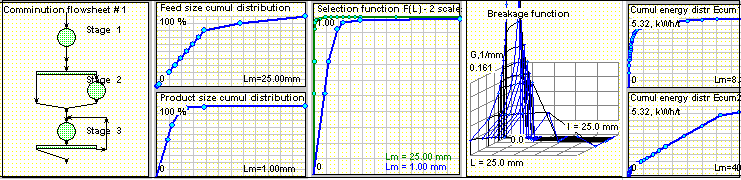
Brief information about dialog programs of UniCruGr package is following.
Program SBF (Calculating selection and breakage functions) finds selection F(L) and breakage G(L,l) functions for a given crushing / grinding circuit or flowsheet using experimentally measured size distributions of feed Gam1(L) and product Gam2(L) and some measured flowrates. For more accuracy not only one but also several sets of such input data may be used.
Selection F(L) and breakage G(L,l) functions may be presented by the following models:
To specify the models program SBF finds parameters LCO, delha and Kza for F(L). The program also identifies G(L,l), with parameter Kzag or not.
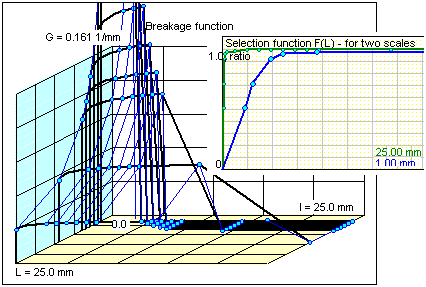
Input data (industrial or / and lab):
Output data: Most appropriate crushing selection and breakage functions and their numeric parameters (or numeric ordinates).
Program CE (Calculating comminution energy parameters) calculates work indices for tested comminution laws and energy flows between size classes of feed and product. Comminution laws estimate energy Esigma for crushing / grinding by following formulas:
where: L1, L2 are sizes of feed and product, microns; Wb, Wr, Wk are coefficients (work indices) dependent mainly on nature of ore, kWh/t.
In these laws the work indices Wb, Wr, Wk (kWh/t) have different physical meaning; so they do not coincide even for similar ores. A law can suit better its own comminution domain. Found laws and work indices estimate ability to comminution of various ores under various conditions of crushing and grinding. They are used for predicting detailed energy consumption for any comminution multistage flowsheets - by programs CCF (Calculationss for crushing flowsheets), CGF (Calculationss for grinding flowsheets).
Input data (industrial or / and lab) contain:
Output data contain:
Program CLI (Comminution law identification) can find most appropriate comminution law for investigated comminution circuit (among laws of Bond, Rittinger, Kick-Kirpitchev, etc.) - starting from experimental sets of measured feed/product size distributions and energy consumption. Identified comminution laws (among laws of Bond, Rittinger, Kick-Kirpitchev, Rebinder, etc.) and work indices estimate ability to comminution of various ores under various conditions of crushing and grinding. They are used for predicting detailed energy consumption for any comminution multistage flowsheets. Input data (industrial or / and lab) contain experimental sets of measured feed / product size distributions and energy consumption. Output data contain identified comminution laws most appropriate for measured conditions.
Program CCF (Calculations for crushing flowsheets) serves for prediction, analysis, optimization of multistage crushing flowsheets (involving energy consumption for crushing). The program CCF calculates size distributions and flowrates for all streams as well as energy consumption for all stages and crushing energy distribution for all size classes.
The program uses input data:
The program predicts following output data:
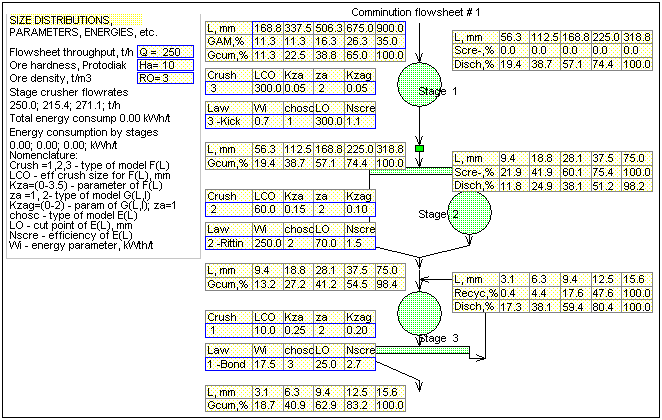
In finding total and differential energies for crushing a new approach is applied additionally to the comminution laws, which estimates energy Esigma for crushing/grinding by following formulas:
where L1, L2 are sizes of feed and product, microns; Wb, Wr, Wk are coefficients (work indices) dependent mainly on nature of ore, kWh/t.
If the law is unknown then the program CLI can find suitable law (Rittinger, Bond, etc.) - starting from experimental sets of measured feed / product size distributions and energy consumption.
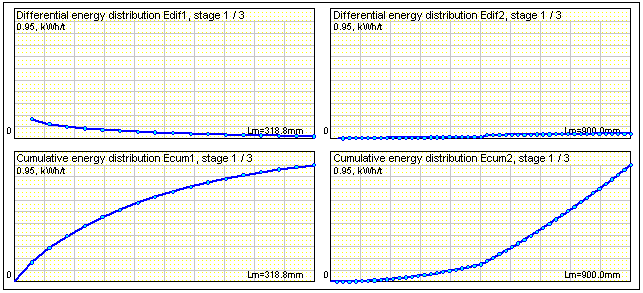
Program CGF (Calculations for grinding flowsheets) serves for prediction, analysis, optimization of multistage grinding flowsheets with calculations of energy consumption for grinding. The program CGF calculates size distributions and flowrates for all flows as well as energy consumption for all stages and grinding energy distribution for all size classes.
The program uses the following input data:
Program CGF predicts the following output data:
Program CGF calculates two types of energy distributions with estimation of energy flows between size classes of feed and product. In finding total and differential energies for grinding a new approach is applied additionally to the comminution laws, which estimate energy Esigma for crushing / grinding by :Bond, Rittinger and Kick formulas.
Program BT (Component balance calculations of multi-outstream- unit flowsheets) makes conventional component balancing calculations to match sampling data of any technological flowsheet. Program BT is valid for flowsheets of arbitrary configuration having multi-outflow units. Program BT is applicable to flotation, gravity separation, magnetic separation and other mineral processing flowsheets.
Program BTMF (Component balance calc for multi-feed flowsheets with multi outstream units) makes conventional component balancing calculations to match sampling data of any technological flowsheet for more complicated cases of multiple feed. Program BTMF is valid for flowsheets of arbitrary configuration having multi-outflow units and multiple feeds. Program BTMF is applicable to flotation, gravity separation, magnetic separation and other mineral processing flowsheets.
Program BF (Fraction balancing calc of flotation flowsheets) finds all technological indices if given flowsheet configuration with parameters and reduced number of measured indices. Innovative ideas are based one separation characteristics of the flowsheet. Input data include: Flowsheet configuration, parameters of unit flotation operations (residence times, etc.), measured yields and grades of several flows (less than for traditional mass balancing). Output data cover corrected values of flotation unit residence times; Separation characteristics for all flows; Mass-balance of flottability fractions for all flows including fraction distributions and fraction grades for all components; Mass-balance of solids and components for all flows including flow rates, yields, grades, recoveries, mass-balance of solid-to-water for all flows. Program BF makes balancing calculations of flotation technological indices not only by the ore components (as in conventional approach), but additionally - with consideration of flotofraction distributions in the flows of a flotation flowsheet, which increases the accuracy of the balancing calculations. In parallel the program BF serves for flotometric analysis of a flotation flowsheet feed.
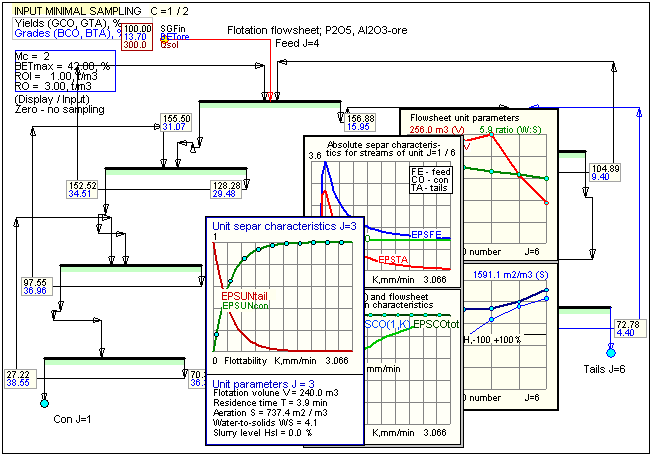
The UniCruGr package includes automated versions of some programs mentioned above. The programs make modified calculations using initial input data from files. The initial input data (sampling / parameters) are modifies on the flowsheet graph. Afterwards modified calculations are immediately performed. Programs Cr_graph, Gr_graph, BT_graph and BF_graph make fast automated calculations performed by programs CCF, CGF, BT and BF. The automated programs are following.
Cr_graph (Automated calculations for crushing flowsheets) serves for prediction, analysis, optimization of multistage crushing flowsheets (involving energy consumption for crushing). The program calculates size distributions and flowrates for all streams as well as energy consumption for all stages and crushing energy distribution for all size classes. This program is automated version of program CCF.
Gr_graph (Calculations for grinding flowsheets) serves for prediction, analysis, optimization of multistage grinding flowsheets with calculations of energy consumption for grinding. The program calculates size distributions and flowrates for all flows as well as energy consumption for all stages and grinding energy distribution for all size classes. This program is automated version of program CGF
Program BT_Graph (Automated component balalnce calculations of multi-outstream-unit flowsheets) makes mass component balance calculations using modified partial (or complete) sampling. Initial data are entered from file for further modification. Program BT_Graph is automated and fast operating version of programs BT and BTF; it makes modified automated component balancing calculations of technological flowsheets.
Program BF_Graph (Automated fraction balance calculations of flotation flowsheets) makes mass component and fraction balance calculations using modified partial (or complete) sampling with additional flotometric analysis and corrected fractional balance. Initial data are entered from file for further modification. . Program BF_graph is express version of program BF; it makes modified automated component balancing calculations of flotation flowsheets.
Program FM (File manager) decodes and displays information saved in data-files.
Central Menu loads optionally one selected program (or several of them for simultaneous operation). A program has its main window where all actions are taking place: the dialog with User, entering input data, calculating output data, displaying the results, etc.
Input and output data: The input data may be entered in data tables and in boxes on the flowsheet graphs, additionally standard input boxes may be used. The output data may be displayed in data tables, in boxes on the flowsheet graphs, in special tables, in along-units graphs and in small pictures.
Mathematical ‘motoring’ part of programs: All mathematical calculations are highly automated. As the configuration of a technological crushing/ grinding flowsheet is entered, the corresponding set of necessary and sufficient equations is automatically formed and further completed and numerically specified. Consequent mathematical calculations cover size distributions, flowrates, energy consumption, selection and breakage functions, etc. For the component / fraction balance calculations, as far as the configuration of crushing / grinding / flotation / separation flowsheet is entered, the corresponding set of equations is automatically composed and further numerically specified. For uniformity the input sampling data are entered as partial yields and recoveries EPSUN(J, I, C), or - alternatively - as grades Be(J, I, C).
Data-files: Input and output information is saved in files having various extensions: \*.sml, \*.sbf, \*.cli, \*.cep, \*.ccf, \*.cgf. The files contain information about flowsheet configuration, size distributions of the flowsheet feed, parameters of comminution stages, predicted technological indices, predicted energies. The files may be observed via program File Manager UCG and program File Manager TechBal.
The UniCruGr package is useful in mineral processing, metallurgy, mining, geology. The package is adaptable to any industrial situation; it is regularly modified.