
BRIEF INFO ABOUT COMPUTER PACKAGE ACFS - AUTOMATED CONTROL OF COMMINUTION, FLOTATION AND SEPARATION; units ACFS-1, ACFS-2, ACFS-3; Russian / English languages; Windows NT, 2000, XP. (For mineral processing, metallurgy, chemistry, mining).
Computer package ACFS serves for automated process control of crushing, grinding, flotation and separation flowsheets of arbitrary configuration. Measuring and control signals are processed in real time operation. The package operation is aimed at maximization of production of fine size ground classes under minimization of energy consumption and at the maximization of recovery of valuables to flotation concentrates of desired grade, or it is aimed at maximization of economic gain per unit mass of processed ore.
The number of comminution / separation (grinding / flotation) circuits and their technological configuration are specified by means of incorporated adjusting procedures. Necessary and sufficient adjusting proceedures take care about measuring and control loops, as well as about special algorithms for correcting measurements and for optimizing control loops, - for all levels of automated control. As a whole the integrated control system may be adjusted to meet various technological requirements and to satisfy various optimality criteria.
For the grinding circuits the control regimes cover a wide range from basic stabilization (throughput, ore accumulation, slurry density, product grain size) - to optimal control with throughput maximization and minimal energy consumption, the product grain size being constraint by flotation. For the flotation flowsheets the control regimes also cover a wide range from basic stabilization (reagents flowrates, slurry aeration, slurry density, slurry level) - to optimal control with flotometric analysis of the processed mineral flows and with separational characteristics of the flowsheets.
Functionally the package ACFS consists of three parts:
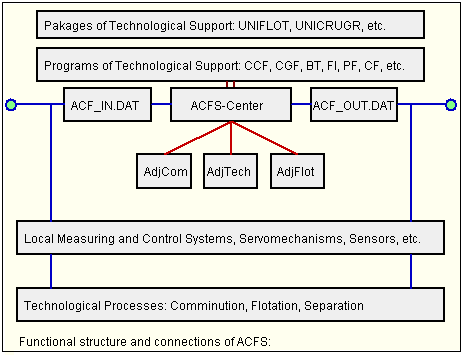
The part ACFS-1 (Center group) processes in real time the signals of local measuring and control systems. The unit ACFS-1 includes the following sub-units:
The center ACFS-M processes measuring signals of sensors. The center ACFS-А processes additionally control signals. The center ACFS-R may substitute ACFS-A and ACFS-M as reserve. Correspondingly the ACFS-1 includes the centers ACFS-A, ACFS-M, ACFS-R and also a number of adjusting programs.
The adjusting programs AdjTec, AdjCom, AdjFlot and AdjSys make the initial adjusting of the whole ACFS control system. The most general program AdjTec is able to manage any mineral processing flowsheets, including comminution and separation / flotation processes. The program AdjTec includes the following sections.
The program AdjCom covers only comminution. Compared with AdjTec the program AdjCom has not got the technological adjusting of the separation / flotation flowsheets (Sec3 is off). The program AdjFlot covers flotation and any separation flowsheets. Compared with AdjTec the program AdjFlot has not got the technological adjusting of the comminution flowsheets (Sec2 is off). The program AdjSys performs the adjusting of measuring and control systems for any configured technological flowsheets.Compared with AdjTec the program AdjSys has not got the technological adjusting of the comminution and separation / flotation flowsheets (Sec2 and Sec3 are off).
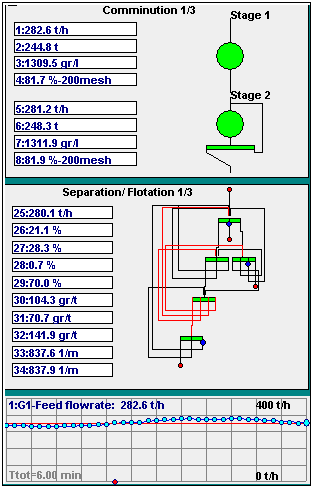
The technological flowsheet, as well as measuring and control hardware, may change with time. These changes should be entered (on line) using re-adjusting of the system. Adjusting is performed at the system start sequencially by a series of dialog input boxes and then for checking - by special table (grid). Re-adjusting is made through the table №1 at run time (without switching off the system). The adjusting includes number of comminution circuits and number of grinding measuring/control loops; number of separation / flotation circuits and number of separation/ flotation measuring / control loops, etc. Any comminution / separation (grinding/ flotation) circuit and any measuring/ control loop should be given an ID, e.g. J=1,2,3,... For any measurer/controller the adjusting requires scaling, error level, correcting algorithm, control algorithm, etc.
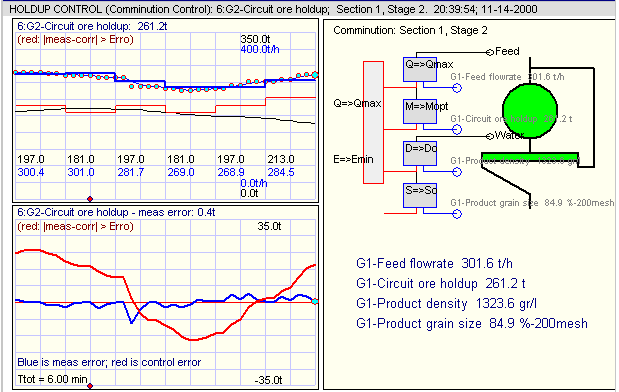
For grinding / crushing processes the lower control level typically includes: feed flowrate, circut ore holdup, slurry density, product grain size. At the upper control level the mill/ crusher holdup is optimized to maximize the throughput and to minimize the energy consumption. The slurry density or cyclone pressure should be corrected to satisfy grain size requirements for separation/ flotation.
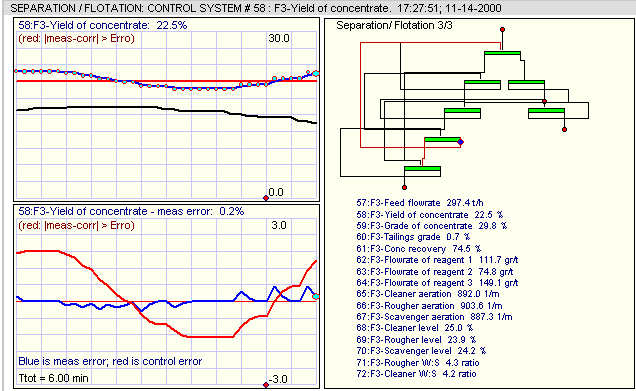
For flotation / separation processes the lower level control includes local control loops dealing with the slurry aeration, the slurry level and the water-to-solid ratio. The upper level covers optimization of flotation feed flotometric composition, optimization of separational characteristics, etc.
The package ACFS-1 manipulates the grinding and flotation / separation processes using a control computer and a network of controllers (e.g. one multi-loop controller for one grinding / flotation circuit). The measuring part of the package ACFS-1 contains a set of measuring algorithms for correction of sensor initial signals, which icrease effectively the accuracy of measurements. Specialized auto-correction may be used. The control part of the package ACFS-1 contains a set of control algorithms, including: standard stabilization, high accuracy control algorithms with 'past ordinates', special algorithms for the processes with big time lag, optimizing extremal algorithms for maximization of grinding throughput, etc.
For the ACFS-1 the controllers and lower automation levels may serve as:
The ACFS-1 is capable to substitute failed controller loops (including reserve), which increases the reliability of the industrial control. During control run time the package ACFS-1 is able to re-adjust operating measuring and control algorithms (for upper and lower control levels), as well as to add-configer new measuring and control circuits to the integrated system. All measuring / control signals and technological data are displayed for a selected grinding / flotation circuit, the set of displayed data being re-adjustable. 'Electronic' tables (grids) display the detailed data of the nearest past (e.g.1 hour), as well as one-hour averaged data for 24 hours and one-day averaged data for one month.
If the ACFS system is started from 'zero state' then the adjusting programs AdjTec (AdjCom, AdjFlot) should be started first (load from Central Menu), to enter and save adjustable parameters in files. If the ACFS system is started not from 'zero state', i.e. the adjustable parameters have been saved in the files, then the program 'Start ACFS; Reserved Measuring and Control Center ACFS-R' should be loaded from the Central Menu.
The program ACFS-R inputs the adjustable parameters from the data files and loads the programs of the Center group (ACFS-1), namely: 'Measuring and Control Center ACFS-A' and ' Measuring Center ACFS-M' (also ACFS-R as reserved center).
The part ACFS-2 includes dialog programs CCF, CGF and automated programs Cr_graph, Gr_graph - for technological calculations of crushing and grinding processes (a part of UniCruGr package). The part ACFS-3 includes dialog programs BT, BTMF, BF, PF, CF and automated programs BT_graph, BF_graph, FI_graph, PF_graph, CF_graph - for technological calculations of flotation / separation processes (a part UniFlot package). The programs take care about technological / economical optimization of the comminution and flotation / separation processes. Special analyzing / predicting / optimizing procedures take care about grinding energy analysis, about flotometric analysis of flotation flows, about optimization of separational characteristics of flotation flowsheets, etc. The parts ACFS-2 and ACFS-3 serve for optimization of the comminution and flotation / separation processes. The dialog programs of technological support may be loaded from the Central Menu at any time without preliminary adjusting; they cover the following calculations:
Additionally to the dialog programs of technological support the ACFS package uses automated programs to perform quickly all technological calculations without displaying details, using past data saved in files. These automated programs are following:
All automated programs may be loaded via drag-drop movable selector from the operating measuring / control center (or from menu 'T-sup', or from Central menu).
More details about these programs are following.
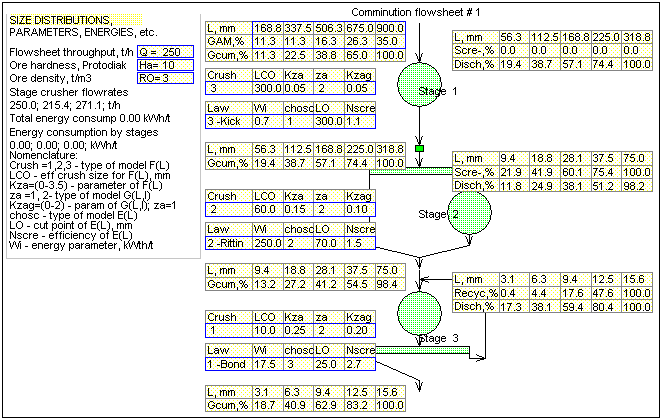
Program CCF (Calculations for crushing flowsheets) serves for prediction, analysis, optimization of multistage crushing flowsheets (involving energy consumption for crushing). The program CCF calculates size distributions and flowrates for all streams as well as energy consumption for all stages and crushing energy distribution for all size classes. The program uses input data: feed size distribution, comminution circuit configuration, crushing characteristics and parameters, screening characteristics. The program predicts following output data: flowrates and size distributions for all flows, total and differential energies for crushing. Program CCF calculates two types of energy distributions with estimation of energy flows between size classes of feed and product. In finding total and differential energies for crushing a new approach is applied additionally to the comminution laws (Bond, Rittinger, Kick)
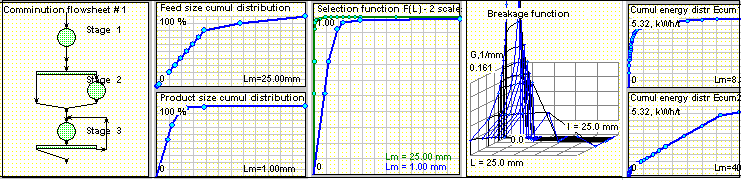
Program CGF (Calculations for grinding flowsheets) serves for prediction, analysis, optimization of multistage grinding flowsheets with calculations of energy consumption for grinding. The program CGF calculates size distributions and flowrates for all flows as well as energy consumption for all stages and grinding energy distribution for all size classes. The program uses the following input data: feed size distribution, ginding flowsheet configuration, grinding parametric characteristics. Program CGF predicts the following output data: flowrates and size distributions for all flows, total and differential energies for grinding. Program CGF calculates two types of energy distributions with estimation of energy flows between size classes of feed and product.
Program BT (Component balance calculations of multi-outstream- unit flowsheets) makes conventional component balancing calculations to match sampling data of any technological flowsheet. Program BT is valid for flowsheets of arbitrary configuration having multi-outflow units. Program BT is applicable to flotation, gravity separation, magnetic separation and other mineral processing flowsheets.
Program BTMF (Component balance calc for multi-feed flowsheets with multi outstream units) makes conventional component balancing calculations to match sampling data of any technological flowsheet for more complicated cases of multiple feed. Program BTMF is valid for flowsheets of arbitrary configuration having multi-outflow units and multiple feeds. Program BTMF is applicable to flotation, gravity separation, magnetic separation and other mineral processing flowsheets.
Program BF (Fraction balancing calc of flotation flowsheets) finds all technological indices if given flowsheet configuration with parameters and reduced number of measured indices. Innovative ideas are based one separation characteristics of the flowsheet. Input data include: Flowsheet configuration, parameters of unit flotation operations (residence times, etc.), measured yields and grades of several flows (less than for traditional mass balancing). Output data cover corrected values of flotation unit residence times; Separation characteristics for all flows; Mass-balance of flotability fractions for all flows including fraction distributions and fraction grades for all components; Mass-balance of solids and components for all flows including flow rates, yields, grades, recoveries, mass-balance of solid-to-water for all flows. Program BF makes balancing calculations of flotation technological indices not only by the ore components (as in conventional approach), but additionally - with consideration of flotofraction distributions in the flows of a flotation flowsheet, which increases the accuracy of the balancing calculations. In parallel the program BF serves for flotometric analysis of a flotation flowsheet feed.
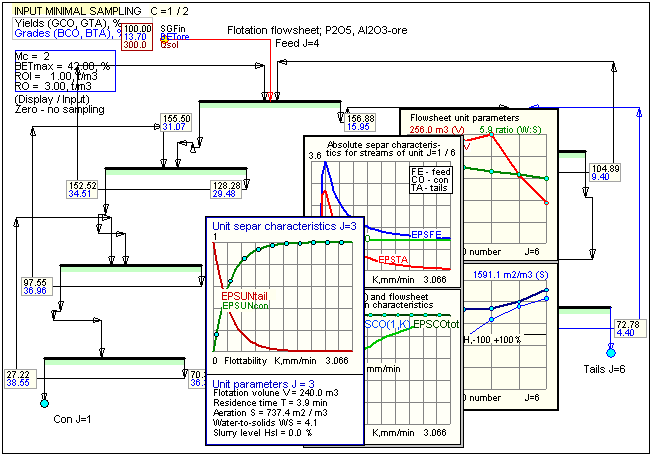
Program PF (Predictive calculations for flotation flowsheets) predicts the technological indices if given flotometric data on feed ore and the flowsheet configuration and parameters. Input data: flotometric composition of processed feed ore (flotability distribution and fraction grade for all valuable and contaminating ore components); flowsheet configuration (number of cleaners and scavengers, connections); parameters of flotation units (residence times, air holdups, etc.). Output data: tonnage, yield, grade, recovery for all flows; separational behavior of any path through the flowsheet; effects on all the indices caused by changes in residence times of flotation units, air holdups of the units, fractional composition of the feed ore, configuration of a flowsheet, etc. Program PF makes predictive calculations of technological and other indices (yields, grades, recoveries, etc.) for industrial flotation flowsheets; based on the flowsheet configuration, unit parameters, feed ore fractional composition.
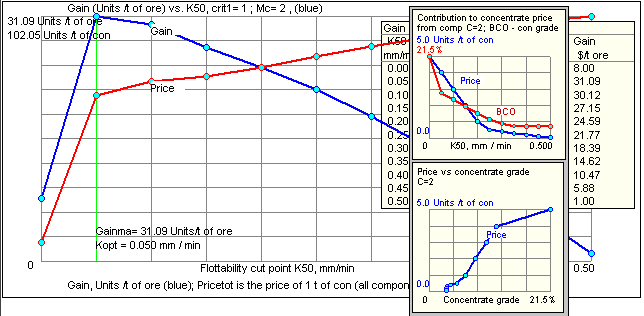
Program CF (Optimal control of flotation flowsheets) finds optimal manipulated parameters of industrial flotation flowsheets using measured actual yields and grades of flows. Program CF serves for upper control level of industrial flotation. Using data on the flowsheet configuration, actual unit parameters and sampled yields and grades of flows the program finds values of available manipulated control inputs: flowsheet cutpoint, unit residence times, air holdups, solid-to-water ratios - to satisfy optimality criteria. Program CF calculates optimal control commands (unit aeration S(J), unit water-to-solid WS(J), etc.), for the upper control level, using selected optimality criteria (technological, economical). The program CF keeps optimal performance of an industrial flotation flowsheet under fluchtuating feed ore composition and other disturbances.
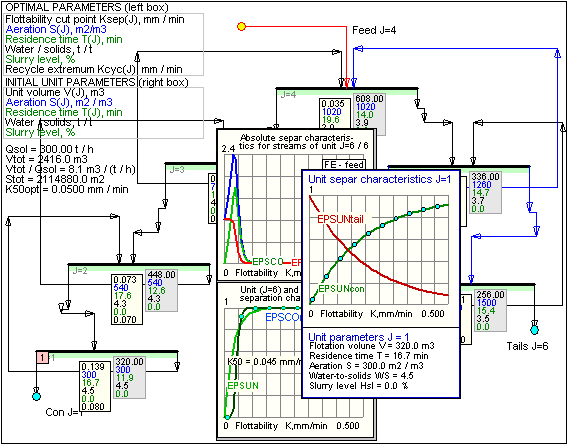
There are automated versions of some programs mentioned above.The programs make modified calculations using initial input data from files. The initial input data (sampling, parameters, etc.) are modifies on the flowsheet graph. Afterwards modified calculations are immediately performed. The automated programs are following.
Cr_graph (Automated calculations for crushing flowsheets) serves for prediction, analysis, optimization of multistage crushing flowsheets (involving energy consumption for crushing). The program calculates size distributions and flowrates for all streams as well as energy consumption for all stages and crushing energy distribution for all size classes. This program is automated version of program CCF.
Gr_graph (Calculations for grinding flowsheets) serves for prediction, analysis, optimization of multistage grinding flowsheets with calculations of energy consumption for grinding. The program calculates size distributions and flowrates for all flows as well as energy consumption for all stages and grinding energy distribution for all size classes. This program is automated version of program CGF
Program BT_Graph (Automated component balalnce calculations of multi-outstream-unit flowsheets) makes mass component balance calculations using modified partial (or complete) sampling. Initial data are entered from file for further modification. Program BT_Graph is automated and fast operating version of programs BT and BTF; it makes modified automated component balancing calculations of technological flowsheets.
Program BF_Graph (Automated fraction balance calculations of flotation flowsheets) makes mass component and fraction balance calculations using modified partial (or complete) sampling with additional flotometric analysis and corrected fractional balance. Initial data are entered from file for further modification. . Program BF_graph is express version of program BF; it makes modified automated component balancing calculations of flotation flowsheets.
Program FI_Graph (Automated flotometry in industry) calculates flotometric composition of feed ore and flows of an industrial flowsheet if given its parameters and sampled indices. Input data: flowsheet configuration; parameters of units (volumes, residence times, air holdups, solids-to-water ratio); measured yields and grades of some flows. Output data: fractional flotometric composition of the feed ore; fractional composition of all streams of the flowsheet. Program FI_graph is express version of program FI.
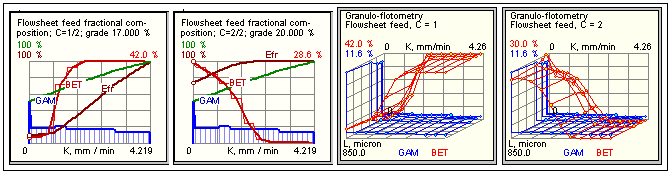
Program PF_Graph (Automated predictive calculations of flotation flowsheets) predicts the technological indices if given flotometric data on feed ore and the flowsheet configuration and parameters. Input data: flotometric composition of processed feed ore (flotability distribution and fraction grade for all valuable and contaminating ore components); flowsheet configuration (number of cleaners and scavengers, connections); parameters of flotation units (residence times, air holdups, etc.). Output data: tonnage, yield, grade, recovery for all flows; separational behavior of any path through the flowsheet; effects on all the indices caused by changes in residence times of flotation units, air holdups of the units, fractional composition of the feed ore, configuration of a flowsheet, etc. Program makes predictive calculations of technological and other indices (yields, grades, recoveries, etc.) for industrial flotation flowsheets; based on the flowsheet configuration, unit parameters, feed ore fractional composition. Program PF_graph is express version of program PF.
Program CF_Graph (Automated calculations for optimal control of flotation flowsheets) calculates optimal control commands of upper level for flotation flowsheets; preliminarily the program makes mass balance calculations using modified partial (or complete) sampling with additional flotometric analysis. Initial data are entered from file for further modification. Program CF_Graph is automated and fast operating version of program CF.
Additionally program FM (File manager) decodes and displays information saved in data-files.
Default configuration of the ACFS package may be following: the unit ACFS-1 is installed at a separate PC using the file data exchange FDE (or DDE) between the components of the integrated system. The units ACFS-2 (TC-support) and ACFS-3 (TS-support) are installed either on the same computer or on another computers mainly for dialog operation.
Mathematical ‘motoring’ part of ACFS-2 and ACFS-3: All mathematical calculations are highly automated. As the configuration of a technological crushing / grinding / flotation / separation flowsheet is entered, the corresponding set of necessary and sufficient equations is automatically formed and further completed and numerically specified. Consequent mathematical calculations cover component balance and fraction balance equations (50 flotation fractions). Most sophisticated calculations cover flotometric analysis including solution of sophisticated equations of special integral-type.
Data-files: Input and output information is saved in files having several different extensions:\*.ccf, \*.cgf., \*.sml, \*.ore, \*.orl, etc. The files contain information about flowsheet configuration, flotability fraction composition of a flowsheet feed, parameters of flotation units, flowsheet sampling data, predicted technological indices, water-solid balance data, lab flowsheet configuration, flotability fraction composition of a lab ore sample, sampling data of lab flotation kinetics, parameters of lab flotation kinetics, concentrate prices. The files may be observed via program File Manager (FM).
ACFS package is useful in mineral processing, metallurgy, chemistry, mining. It is adaptable practically to any industrial situation; the package is permanently developing.